Research & Writing
Research that connects policy, finance, and the realities of leading schools.
My research interests center on educational leadership, private-school sustainability, school choice, organizational decision-making, and the financial realities facing K–12 schools.
My doctoral research examined how leaders of small private schools in Florida navigate the relationship between state scholarship funding and tuition-setting decisions—particularly the tension between maintaining affordability for families and building financially sustainable schools.
My doctoral study surveyed 85 decision-making leaders of Florida private K–12 schools with fewer than 500 students. Using resource dependence theory, the study examined leaders' perceptions of scholarship funding, tuition income, affordability, sustainability, and tuition-setting decisions.
Read the Full Dissertation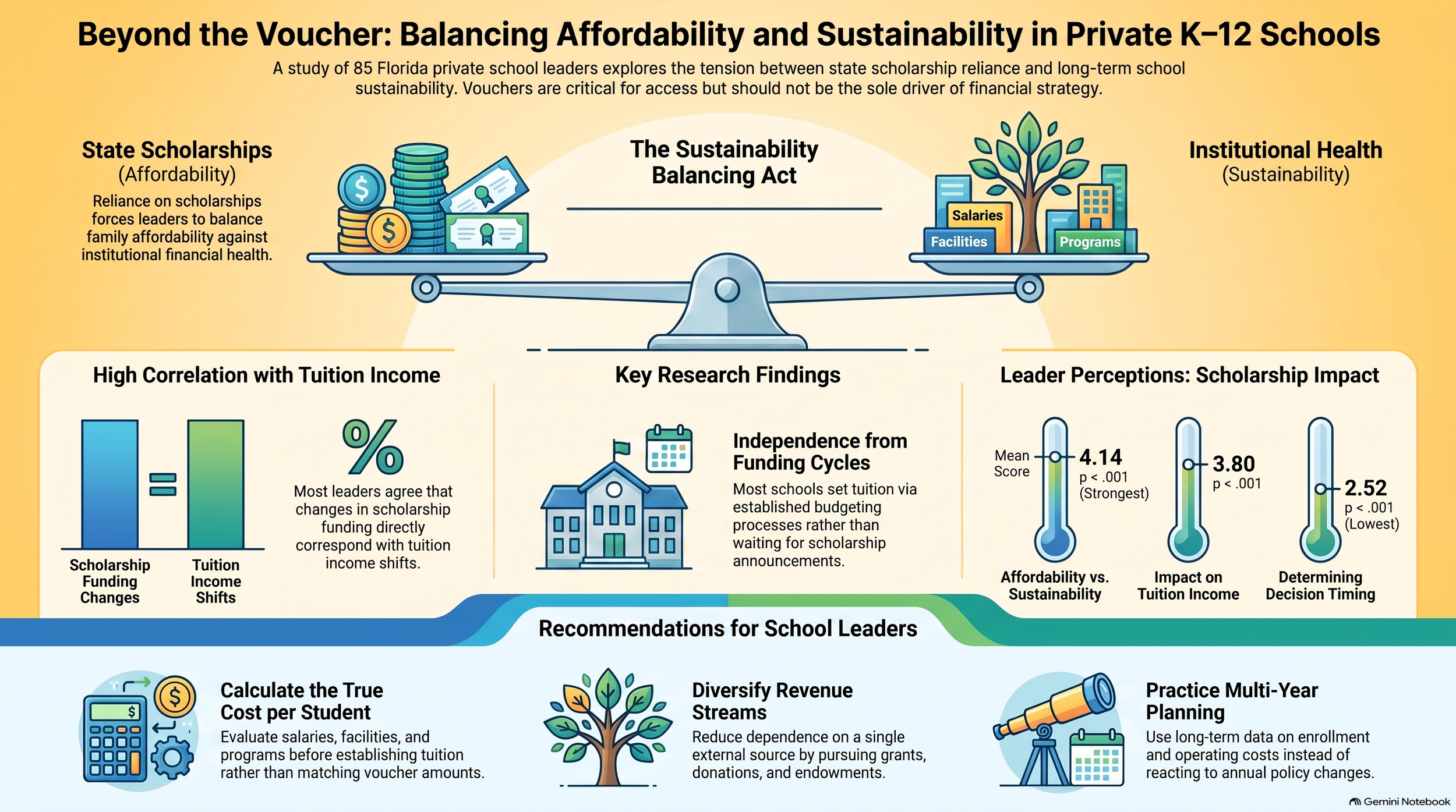
Copyright Rebekah Kogelschatz, may not be used without permission or citation.
What the Research Found
The findings provide insight into how private-school leaders view scholarship funding, affordability, tuition decisions, and long-term financial sustainability.
School Leaders
Decision-making leaders from Florida private K–12 schools participated in the study.
Affordability & Sustainability
Leaders strongly agreed that tuition decisions attempt to balance affordability for families with institutional sustainability.
Resources Beyond Vouchers
Leaders strongly agreed that schools need funding beyond voucher amounts to support financially sustainable decisions.
Scholarship Expansion
Leaders generally agreed that expanded scholarship eligibility contributed to enrollment growth and tuition revenue.
Time to Respond
Leaders expressed considerably less agreement that schools have adequate time to adjust tuition in response to changes in scholarship guidelines or amounts.
The findings did not indicate that schools simply set tuition according to scholarship amounts. Tuition decisions occur within a broader organizational context that includes enrollment, operating costs, affordability, governance, and long-term sustainability.
Behind the Numbers
The survey also provides a broader picture of the financial and governance environment represented by participating schools.
Responding schools reported offering financial assistance, variable tuition, or financial aid.
Reported that non-tuition sources represented 10% or less of their annual budget.
Responses indicated that an independent church or school board participated in budgeting decisions.
Where the Research Can Go Next
The dissertation answered a specific set of questions, but it also revealed new ones worth exploring.
Longitudinal Tuition & Scholarship Trends
How do tuition rates change over time as scholarship amounts, eligibility, enrollment, salaries, and operating costs change?
School Size & Financial Vulnerability
Do very small private schools experience scholarship dependence differently from larger private schools?
Enrollment Growth & Capacity
What happens when increased access and enrollment meet staffing, facility, or program capacity?
The True Cost of Educating a Student
How closely do tuition and scholarship amounts reflect the actual cost of salaries, facilities, programs, technology, and student services?
Revenue Diversification
Do schools with stronger fundraising, donations, endowments, or auxiliary revenue make different tuition decisions?
Affordability vs. Sustainability
At what point does maintaining affordability begin to constrain salaries, facilities, programs, or long-term institutional health?
Leadership & Governance
How do boards, Heads of School, business managers, and other decision makers approach tuition and financial sustainability?
Beyond Florida
How do these relationships compare across states with different school-choice funding structures?
Research Into Practice
Data matters most when it informs better decisions.
My interest in research extends beyond publication. I am particularly interested in translating research findings into practical information school leaders can use when considering tuition, enrollment, budgeting, organizational sustainability, and long-term planning.
That connection between research and practice informs my consulting, professional learning, writing, and speaking.
Continuing the Conversation
My current writing and research interests include school choice, private-school finance, organizational sustainability, educational leadership, innovation, and the changing landscape of K–12 education.
Future research, articles, presentations, and other publications will be added here as that work develops.
Research or Collaboration Inquiry